
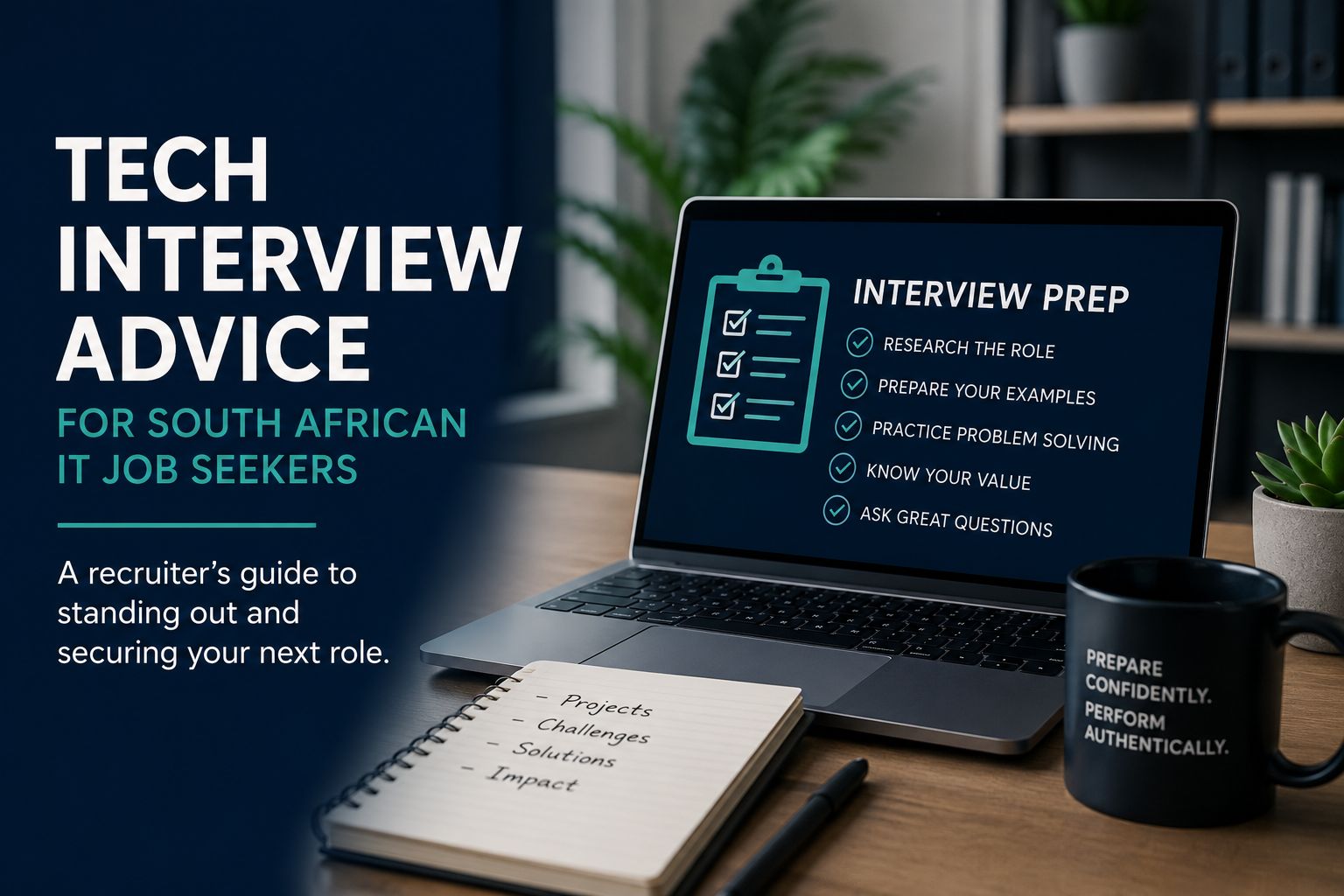
Tech Interview Advice for South African IT Job Seekers (2026)
Your CV gets you the interview. Your interview gets you the job.
If you’re preparing for a tech interview in South Africa, the right preparation can make the difference between receiving an offer and missing out on an opportunity that could change your career.
Every week, I interview software developers, DevOps engineers, QA specialists, cloud engineers, business analysts, project managers, data professionals and technology leaders. Over the years, I’ve interviewed thousands of IT professionals, and the same patterns appear time and time again.
The candidates who receive offers aren’t always the ones with the longest CVs or the most certifications.
They’re the ones who can clearly explain how they think, how they solve problems and the value they’ve delivered.
This guide shares the interview advice I give technology professionals before they meet hiring managers.
In this guide
- Why understanding the role matters more than researching the company
- How to answer technical interview questions with confidence
- The biggest mistakes candidates make in IT interviews
- How to talk about AI in interviews
- Salary, notice period and other questions South African employers will ask
- Questions you should ask the interviewer
- Practical interview tips that help you stand out
A Recruiter’s Insight
After interviewing thousands of technology professionals, I’ve learned something that surprises many candidates.
Very few people lose interviews because they aren’t technically capable.
Far more lose opportunities because they struggle to explain what they’ve done, why they made certain decisions or how they approach solving problems.
The good news?
Communication is a skill. Like any technical skill, it can be improved with practice.
- Understand the role, not just the company
Many candidates spend hours researching the company’s history, values and products.
That’s useful.
But it isn’t enough.
The better question is:
Why is this company hiring for this role?
Every vacancy exists because the business has a problem it wants solved.
Maybe they’re scaling.
Maybe they’re modernising legacy systems.
Maybe they’re replacing someone who has left.
Maybe they need to improve performance, automate processes or strengthen cybersecurity.
Read the job description carefully and ask yourself:
- Which three or four skills appear most important?
- What challenges might this person face in the first six months?
- How does my experience help solve those problems?
When you understand the reason behind the role, your answers become far more relevant.
- Don’t tell them what your team did. Tell them what you did.
This is probably the biggest interview mistake I see.
Candidates often say:
“We migrated our applications to Azure.”
That’s a good project.
But what did you do?
Instead, explain:
- What you were responsible for
- The decisions you made
- The challenges you encountered
- How you solved them
- What the outcome was
For example:
Less effective
“I worked on an Azure migration.”
More effective
“I led the migration of two production applications to Azure. One challenge was reducing downtime during deployment, so we implemented a blue-green deployment strategy that allowed us to switch users across with minimal disruption.”
Specific examples create confidence.
General statements don’t.
- Prepare stories, not scripts
Many candidates try to memorise interview answers.
Experienced interviewers notice this almost immediately.
Instead, prepare examples from your own career.
Think about times when you:
- Solved a difficult technical problem
- Improved system performance
- Automated a manual process
- Resolved a production incident
- Worked through disagreement within a team
- Learned a new technology under pressure
- Made a mistake and what you learned from it
Real experiences sound natural because they’re true.
You don’t have to remember them.
You lived them.
- Be honest about what you don’t know
No technology professional knows every programming language, framework or cloud platform.
Hiring managers know that.
If you haven’t worked with Kubernetes, Snowflake, Terraform or React, don’t pretend you have.
Instead, say something like:
“I haven’t had the opportunity to use it in a production environment yet, but I’ve been learning it independently and this is how I’d approach solving that problem.”
Honesty builds trust.
Trying to bluff your way through a technical interview usually has the opposite effect.
- Think out loud during technical interviews
One mistake many candidates make is staying completely silent while solving a technical problem.
Remember, interviewers aren’t only assessing whether you reach the correct answer.
They’re assessing how you think.
Explain your reasoning.
Discuss different approaches.
Ask clarifying questions if something isn’t clear.
Talk about trade-offs.
Even if your final answer isn’t perfect, demonstrating structured problem-solving often leaves a stronger impression than arriving at the right answer without explaining how you got there.
- Be ready to discuss AI
Artificial intelligence is becoming part of everyday software development.
Most employers know candidates use tools such as ChatGPT, GitHub Copilot and other AI assistants.
The important question isn’t whether you use AI.
It’s how you use it.
Be prepared to explain:
- When AI helps you work more efficiently
- How you verify its output
- When you choose not to rely on AI
- How you ensure the quality and security of your work
The strongest candidates see AI as a tool that supports their thinking, not a replacement for it.
- Know your practical details
Every South African recruiter has experienced this.
You ask a candidate about their salary expectations.
They open a calculator.
Or they aren’t sure what their current package includes.
Before every interview, know:
- Your current CTC
- Your expected salary
- Your notice period
- Your location
- Whether you’re willing to relocate
- Whether you’re open to onsite, hybrid or remote work
- Your qualifications and certifications
Having these answers ready demonstrates professionalism and confidence.
- Communication is a technical skill
Many candidates assume interviews are purely about coding.
In reality, most technology roles require constant communication.
Can you explain a complex technical issue to someone who isn’t technical?
Can you justify why one solution is better than another?
Can you communicate clearly when something goes wrong?
Technical ability might get you shortlisted.
Communication often determines who receives the offer.
- Prepare thoughtful questions
Almost every interview ends with:
“Do you have any questions for us?”
Please don’t answer:
“No, I think you’ve covered everything.”
Instead, ask questions that show genuine curiosity.
For example:
- What would success look like after six months?
- Why is this role available?
- What technical challenges is the team currently facing?
- How does the engineering team approach learning and development?
- What does your deployment process look like?
- How do teams collaborate across the business?
Good questions show you’re evaluating the opportunity as carefully as the employer is evaluating you.
- Don’t overlook the basics
Whether your interview is online or in person, the small things still matter.
If you’re interviewing remotely:
- Test your internet connection.
- Check your camera and microphone.
- Join a few minutes early.
- Choose a quiet, well-lit space.
- Keep your phone nearby as a backup.
If you’re interviewing in person:
- Arrive early.
- Dress appropriately for the company.
- Bring copies of your CV if requested.
- Switch your phone to silent.
Preparation reduces stress.
And when you’re less stressed, you’re more likely to perform at your best.
The most common interview mistakes I see
Across thousands of interviews, these are the mistakes that come up most often:
- Talking only about the team instead of your own contribution.
- Exaggerating technical experience.
- Failing to research the role.
- Giving vague answers without examples.
- Memorising scripted responses.
- Not preparing questions for the interviewer.
- Being unable to explain projects listed on the CV.
- Relying on buzzwords instead of practical experience.
Every one of these mistakes is avoidable.
What South African hiring managers notice in the first few minutes
Long before a technical assessment begins, hiring managers are already forming an impression.
They notice whether you’ve taken the time to understand the role.
They notice whether you can explain the projects on your CV without hesitation.
They notice whether you speak about your own contribution rather than hiding behind “we”.
They notice whether you’re curious about the business or simply looking for any job.
Most importantly, they notice whether you communicate with clarity.
You don’t need to sound perfect.
You need to sound genuine.
Frequently Asked Questions
How do I prepare for a tech interview in South Africa?
Read the job description carefully, research the company, prepare examples of projects you’ve worked on, practise explaining your thinking and know your salary expectations, notice period and availability before the interview.
What questions are asked in software developer interviews?
Expect questions about previous projects, technical decisions, debugging, architecture, problem-solving, teamwork, coding practices and how you’ve handled challenges in previous roles.
Should I tell interviewers that I use AI?
Yes.
Most employers understand that AI tools are becoming part of modern software development.
Be honest about how you use them and demonstrate that you can evaluate and validate their output.
What if I don’t know the answer to a technical question?
Don’t guess.
Explain your thought process, ask clarifying questions and describe how you would approach solving the problem.
Interviewers often learn more from your reasoning than from a perfect answer.
Final thoughts
After interviewing thousands of technology professionals across South Africa, one lesson stands out above all the others.
Your CV tells an employer what you’ve done.
Your interview shows them how you think.
Technology will continue to evolve.
New programming languages will emerge.
AI will reshape the way we work.
But employers will always value people who can solve problems, communicate clearly and learn continuously.
Don’t focus on giving perfect answers.
Focus on giving honest ones, supported by real examples from your own experience.
That’s what builds trust.
And trust is often what turns an interview into a job offer.
About the Author
Therese Otten is the Founder and Senior IT Recruitment Consultant at DataTech Recruitment, a specialist IT recruitment agency based in South Africa. She partners with SMEs, start-ups and established technology teams to recruit software developers, DevOps engineers, cloud specialists, cybersecurity professionals, business analysts, project managers, data professionals and other technology talent. Having interviewed thousands of IT professionals throughout her career, she is passionate about helping both candidates and employers make better hiring decisions.
Follow The Hiring Edge Newsletters on LinkedIn for more strategic insights.
View all our vacancies here
Recent Posts
- The Counteroffer Isn’t a Compliment. It’s a Confession.
- Tech Interview Advice for South African IT Job Seekers (2026)
- Stretching the Truth on a CV Doesn’t Work. Here’s Why.
- When to Stay and When to Go: How to Know It’s Time to Move On
- The Hidden Job Market: How Most Jobs Are Never Advertised
- LinkedIn is your new CV – Are you using it right?
- Your CV Is Killing Your Chances (And How to Fix It)
- What Fractured in 2025 and the Resilience Shaping 2026
- The Unique Month Everyone Underestimates for Hiring – December
- The Art of Reference Checking
- 5 Critical Steps Before You Post That Job
- The best candidates don’t apply. They get found
- Hiring Developers: Expectation vs Reality
- Interview Tip: Don’t be a Chicken at KFC
- Most effective method to communicate with Recruiters
- The 2025 Job Search Reality Check: What you Need to Know
- Jobseekers: You asked, we answered
- Are you looking for a new role?
- Interviews can be nerve-wracking
- Making a Lasting Impression During an Interview
- 3 Top Tips for Staying positive during your job search
- Everyone is a Genius at heart!
- Celebrating 5 Years of Excellence with DataTech Recruitment
- The Rise of Interview Proxies: An astonishing trend
- Successfully track your job applications in real-time
- Embrace the promising last half of 2024
- Addressing Imposter Syndrome to profit from your job search
- Honesty is the best Policy in your job search
- IT Recruitment Agency of the Year 2024 – Southern Africa
- Exciting news for job seekers in South Africa!
- The Great Resignation Hangover: Are We Still Feeling the Buzz?
- The Candidate Experience: Your Secret Weapon in a Competitive Hiring Landscape
- Before You Publish: Uncommon Considerations for Hiring Triumph
- The Freelance Recruiter’s Journey: Powerful and Exciting
- Interpreting Talent Acquisition and Retention: A Podcast Conversation
- A Recruiter’s Guide: Avoid these simple CV Mistakes
- The Downside of Counteroffers 😮
- 🎄 Navigating Job Hunts & Recruitment in the Festive Season
- Unlock Your Career Potential: Mastering the Art of Applying with the Right skills!
- African Excellence Awards: Best IT Recruitment Agency in South Africa
- Celebrating DataTech Recruitment’s Triumph at the AI Acquisition International Business Excellence Awards 2023
- What are companies looking for in an IT CV
- Best Boutique IT Recruitment Agency in South Africa
- Tips to Hiring Managers on Interviewing Software Developers
- Benefits of reading a Job Specification before applying for a job
- How to Reach Out to Recruiters or Hiring Managers
- Humorous Observation on the Recruitment Process in South Africa
- We won – Best IT & Digital Recruitment Consultancy – South Africa award
- New year’s resolutions or revolution?
- The evolving role of recruitment
- Productive downtime during Lock-down
- Business Continuity
- Coronavirus leaving you breathless?
- Coffee with DataTech
- What is your reason for coming to work?
- Walking a Tightrope Act
- Why the buzz around DataTech
- January in Recruitment